DAIMO Notify me

a practice of deep self-exploration

Holotropic Breathwork

Breath, music and a person beside you. Nothing else — and that is enough to reach places conversation cannot get to.

This page is about the method itself and about my approach as a facilitator. Dates for the next workshop have not been announced yet — leave a contact and I will write to you when they are.

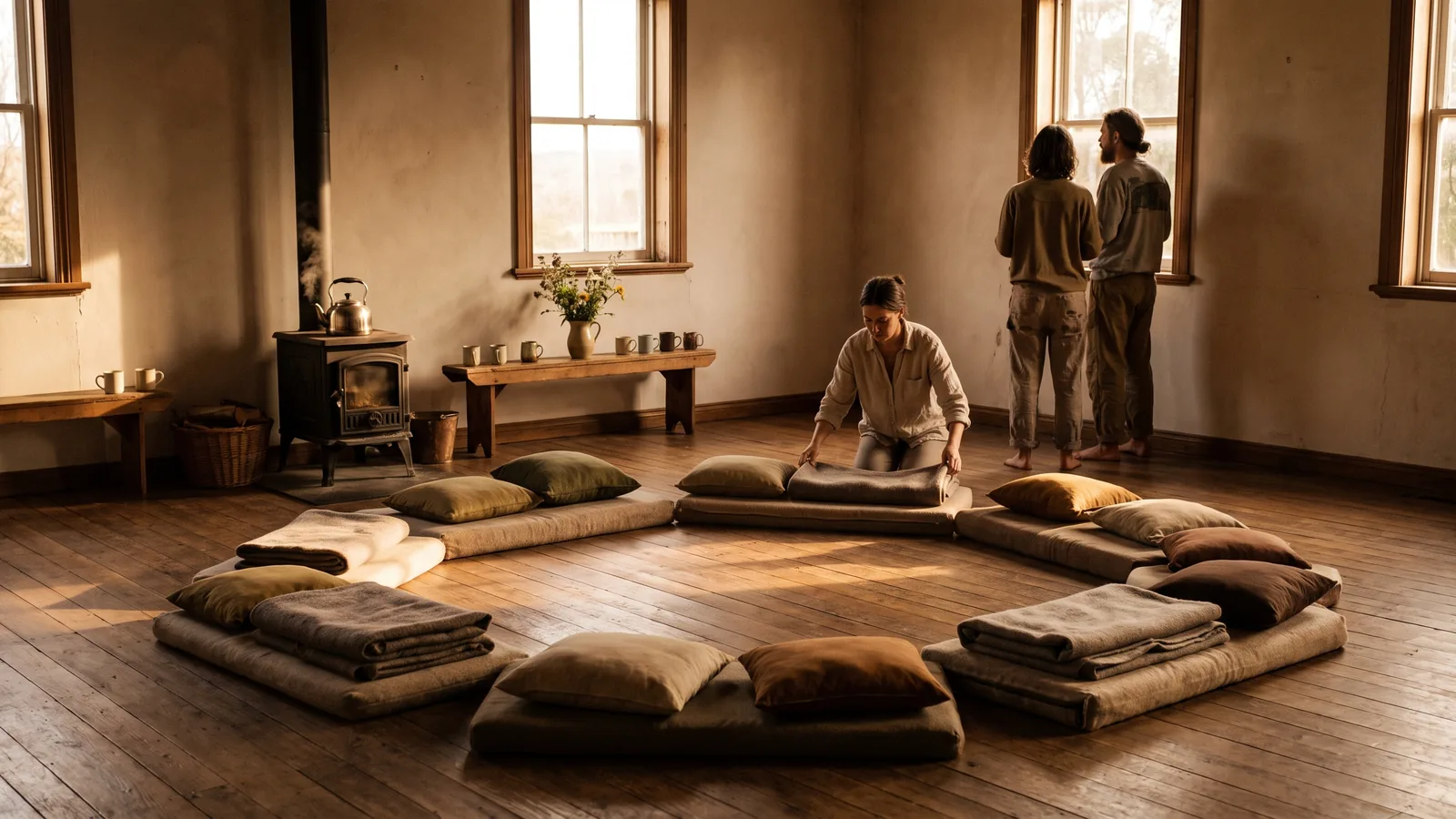
A hall being prepared for a Holotropic Breathwork session: mats, blankets and cushions laid out in a circle, a stove burning in the corner

Half the work is done before anyone starts breathing: the place has to be warm and safe.

What Holotropic Breathwork is

the method

You lie on a mat with your eyes closed and breathe faster and deeper than usual to specially sequenced music. Beside you, the whole time, are your sitter and the facilitator. No substances: only breath, music and support.

Where the method comes from
Created by Stanislav and Christina Grof in the 1970s at Esalen, California, as a continuation of their research into non-ordinary states of consciousness. “Holotropic” comes from the Greek holos (whole) and trepein (moving toward): moving toward wholeness. Over half a century, hundreds of thousands of people worldwide have gone through it.
Who guides the process
Not the facilitator — your own psyche. It brings up exactly the layer of experience that matters most right now, and it doses the load itself. No intention needs to be formulated, and there is no such thing as a “right” experience. You control the depth of the process with your breathing: return to normal breathing and the intensity drops.
Why a facilitator and a sitter
Their role is to hold a safe space: not to steer, not to interpret, not to intervene unnecessarily. When we touch vulnerable layers, it matters to know in the body that someone is there — without that anchor, part of the process simply does not unfold.
What happens in the experience
There is no prescribed sequence: bodily sensations and discharge, emotions, images, forgotten memories, states of stillness and fullness — or a quiet calm session, which is also a session. Grof’s general frame is that the psyche knows how to move toward wholeness on its own, if it is not obstructed.
How it differs from other breathing practices
Rebirthing, Vivation and techniques in the lineage of Reich and Lowen work with similar material but are built differently. The holotropic approach has minimal instruction and maximal space: no step-by-step guidance, no assigned theme, no “correct” outcome — and very dense support of the process by the facilitator and the sitter. That support is exactly what makes the depth possible.
How effective is it
The holotropic approach opens access to wholeness at a depth usually unavailable to rational, conversational methods: body and breath reach where words and analysis hit their limit. It is an experience of personal growth and self-exploration — not a replacement for psychotherapy and not a treatment.

How a day works

format

The usual format is a small group and a full day, or two days in a row. Over a day each participant both breathes and sits: both roles are a full experience, and the second often turns out no less powerful than the first.

1
Opening circle

We gather, introduce ourselves, drink tea, tune in. Breather–sitter pairs are formed.

2
Introduction

How the method works, the breathing technique, the roles, the safety guidelines. Everything you need to know is explained here — no preparation required in advance.

3
First session

Half the group breathes, half accompanies. A session runs about three hours to music built as an arc: build-up, peak, landing.

4
Mandalas

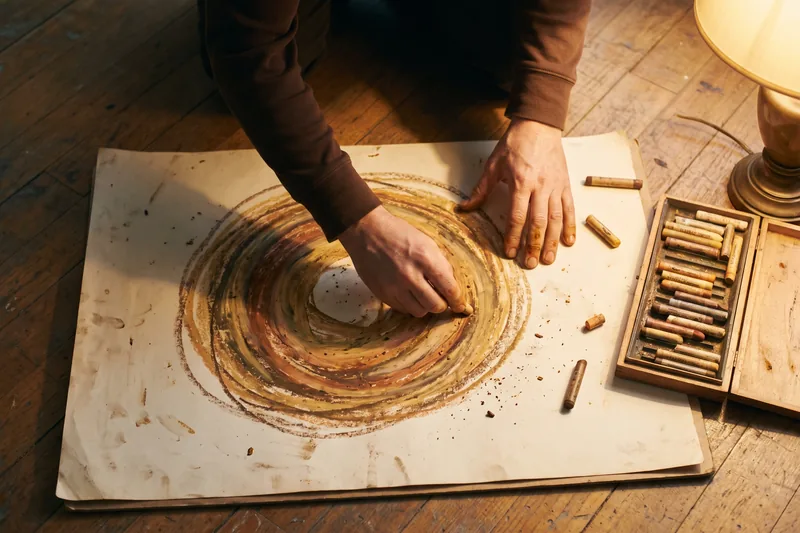
After the session — drawing: a way to give the experience form while it has not yet been translated into words and lost in translation.

5
Break and switching roles

Food, rest, time to be with yourself or outdoors. Then the roles switch.

6
Second session

Those who accompanied now breathe. By this point sitters already carry the experience of being beside someone else’s process — and that changes their own.

7
Sharing

Closing circle: everyone may speak about their experience — or stay silent. Integration begins here.

Hands drawing a mandala with oil pastels on a large sheet of paper on a wooden floor
A mandala after the session. Not art therapy and not an assessment — a way to give the experience form before it is put into words.
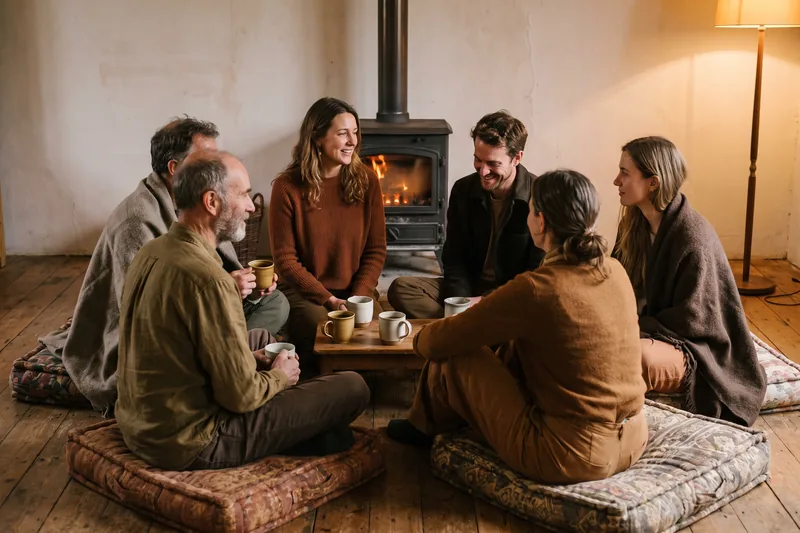
Closing circle: people sit with blankets and mugs of tea by a lit stove, one speaking and the others listening
Sharing. Speaking is optional — but hearing how it was for others usually matters more than people expect.
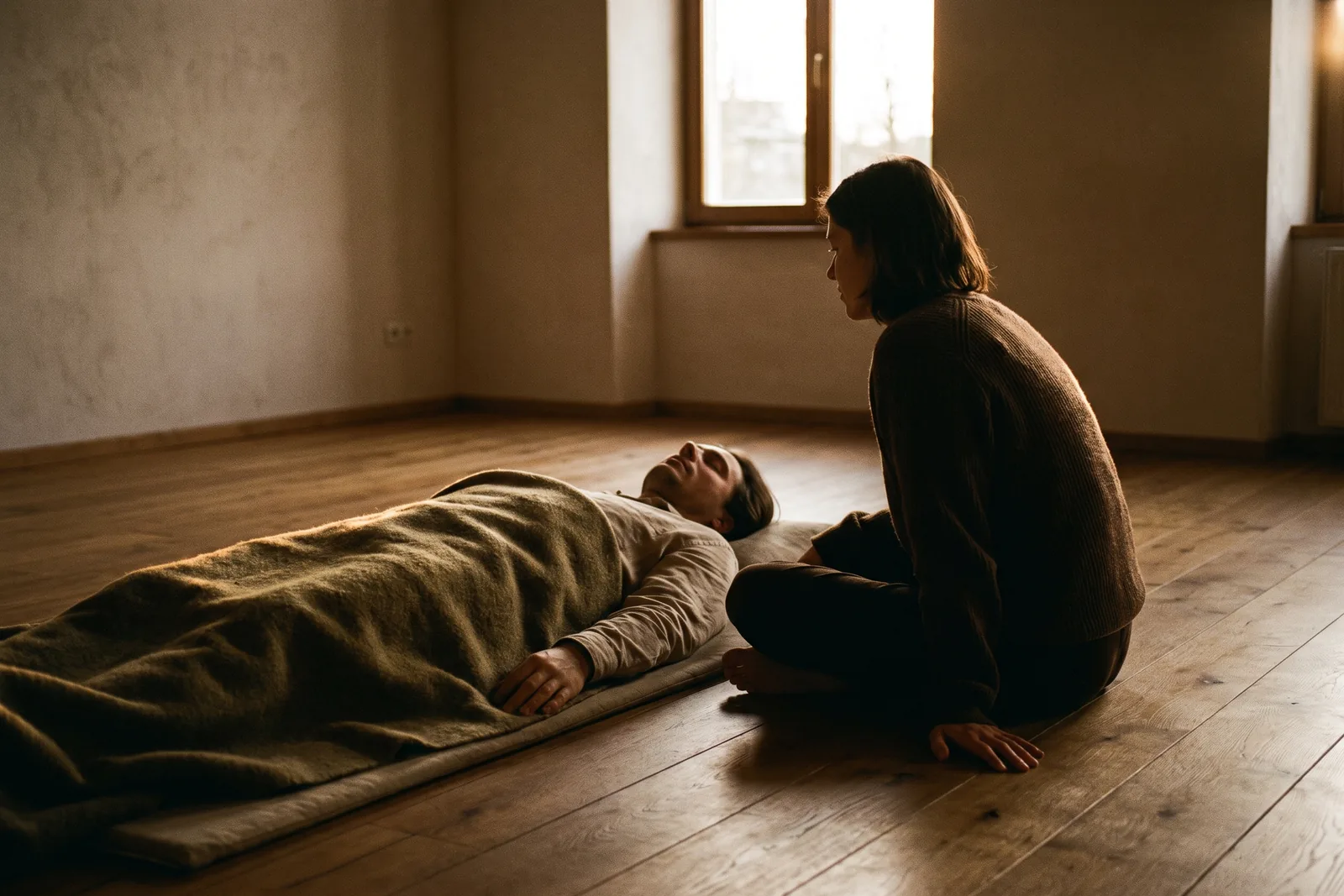
A person lying on a mat under a blanket while a sitter sits quietly beside them on the floor

A sitter does not steer and does not interpret. They are simply there — and without that, part of the process never unfolds at all.

My approach as a facilitator

signature

Every Holotropic Breathwork facilitator has their own flavour and their own style. The method is one; how the field is held, what the person in the facilitator’s chair is made of and how far they can follow you — differs.

My signature is made of four lines that have fused over the years and stopped being separate “methods”.

01 The classical Grof approach

The ground I do not reinvent: the protocol, the roles, the musical arc, focused bodywork at the end of a session, the safety guidelines. The three-year Grof Legacy Training is above all about not getting in the way of the process and being able to stay present with anything.

02 My own deep and integrated experience

I went through the holotropic process myself — at depth and more than once, in a period when my life was coming apart. That experience is lived through and integrated, not read about. In practice it means something simple: whatever comes up for you has most likely passed through me somewhere — and it does not frighten me.

03 A large body of therapeutic and somatic work

Process-oriented therapy in Mindell’s school, transpersonal therapy, years of personal and client practice, somatic work. From this comes discrimination: where a living discharge needs room, where something is stuck and needs support, and where it is better not to touch at all. And from this comes precise, careful work with the body.

04 Spiritual traditions and Taoist work with body, energy and field

Years of immersion in contemplative traditions — and, separately, Taoist approaches to the body, to energy and to the field. This is the least visible part from the outside and the most influential: how the group field is held, how the facilitator’s attention is distributed, how the energy of a session gathers instead of dispersing. Without esoteric fog — as a working instrument.

A path leading away through green hills toward the horizon in morning light
The Taoist line is the least visible from the outside and the most influential from within: it is about how the field is held and where the energy of a session goes.

What follows in practice: I keep the classical protocol honestly and do not blend it with anything else during a session. Everything else works on how it is done — on the quality of presence, the precision of the bodywork, what happens with the group between sessions, and how integration is built afterwards.

A personal invitation

in russian

A short video message from Igor. Spoken in Russian.

Igor Felitsin — video invitation

Facilitator

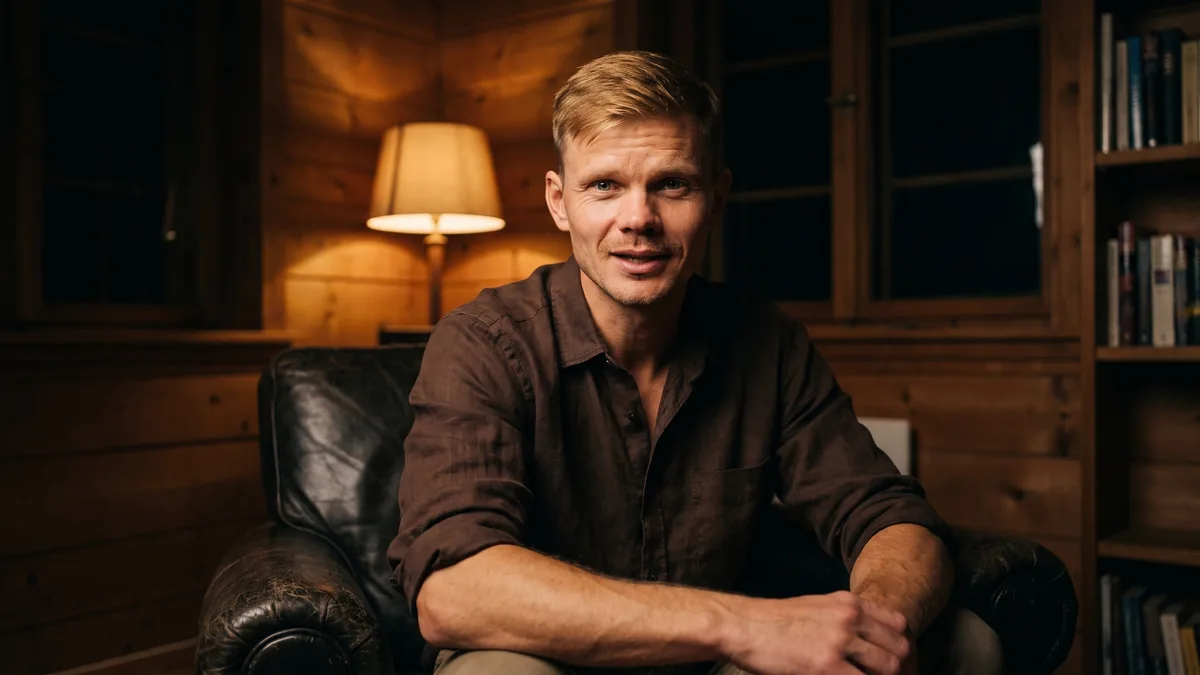
igor felitsin
Igor Felitsin

In my own life the holotropic approach of Stanislav and Christina Grof played one of the key roles. In a period of deep crisis — personal, financial, existential — it became the turning point. Over several years of intensive inner work I managed to rebuild a business after bankruptcy, to build incomparably deeper and warmer relationships with people, and to arrive at a stably different state of mind and quality of life.

I am grateful to this approach, to Stan and to the people who developed the holotropic movement — and I am glad to help it spread further. For millennia there was a tradition of mysteries: a living personal encounter with the sacred that transformed a person. It seems to me that such practices can enrich our time as well.

Certified Grof Legacy Training facilitator

a three-year professional programme of Stanislav Grof’s legacy

Faculty of Psychology, St Petersburg State University (department of ontopsychology) · Faculty of Philosophy, Moscow State University · Executive MBA, Skolkovo · process-oriented therapy · transpersonal psychology, Moscow Institute of Psychoanalysis · Holoscendence with Sergey Kupriyanov · “Integral Awareness” with Evgeny Pustoshkin

What people take home

participants

Words of participants from past workshops: names removed, texts shortened without changing their meaning. Not promises — testimonies.

The armour

On the first day nothing particular happened… But the psyche distributes the load itself — and I came on the second day. It was like a cork being pulled out of a champagne bottle… After the session — the feeling that a rigid armour had been very carefully taken off. Not that the nerves were exposed — more as if I had come home, closer to myself. I had worried that breathwork would destabilise me — the opposite: it gathers what matters inside, and the excess goes.

participant, first Holotropic Breathwork experience

Rebirth

I would describe this year of my life in one word — “rebirth”, and Holotropic Breathwork became a very important part of that process… What did I live through in those two days? Pain, forgiveness, acknowledgement, acceptance, awareness, love. With every cell of my body I felt the inner healer switch on: the body comes alive, believes that I hear it — and I know this will bear fruit.

participant, first experience

A professional’s view

I have known Holotropic Breathwork since 2010, when I first breathed together with several hundred people — and my world turned over… I was delighted by this workshop. How everything was thought through down to the smallest detail. A wonderful team of facilitators… After the workshop there was more energy and inspiration; new ideas for current projects came during the breathing. As a sitter, I admired each participant — how beautiful everyone is in their authenticity.

certified Holotropic Breathwork facilitator (GTT), trauma therapist

The researcher

I was curious how Holotropic Breathwork differs from the inside from rebirthing, Lowen, Reich… And I felt it fully. The “secret” ingredient is the particular support of the process by the facilitators and the sitter… From the first minutes of the first session the main theme was set — and the peak of the second session became its resolution. That is very beautiful. A state remained in my bodily experience that I can return to and draw on. In two words — it is a practice of love.

designer, experienced in other breathing practices

A day of clearing out expectations

I had dreamed that after the session something supernatural would open up for me… There was no wow effect — and if everything had ended on the first day, it would have been one of my biggest disappointments. But now I see it as a day of clearing out expectations… On the second day people opened up in a new way, my labels fell off like leaves in autumn. Being a sitter moved me more: service to people, care for them. What surfaced above all was a precise feeling that all my processes are on time and exactly as they should be.

participant, first experience · we publish this because there is no such thing as a “right” session
“In the first session I felt such boundless love — it is impossible to put into words.”

participant

“The tension in my body released, and I began to trust and open up to people more and more.”

participant

“My endurance in training grew — as if something got cleared, unclenched and started flowing the way it should.”

participant, amateur athlete

“Inner calm, good working capacity, a clear view of things.”

participant, entrepreneur

“A very pronounced lightness in the body. Something evaporated — heavy and pressing.”

participant

“You can lean not only on yourself: sometimes, in trust, you hand your weight over — to people, to the field. It is not about dropping responsibility, it is about accepting support.”

participant, psychologist

“Being a sitter turned out to be no less powerful an experience than breathing myself.”

participant

“I remembered myself, I lived my body and soul anew… I want to return to music again — I had been on a creative pause for a year.”

participant, musician

“This is an order of magnitude above most of what today’s ‘market’ of spiritual and transpersonal practices offers, in quality and in depth.”

practitioner and teacher of somatic practices

“In everything the team did there was service — from the highest mission down to the invisible details.”

yoga teacher

“I am not what happens to me — I am how I respond to it. I consider this, too, an after-effect of the breathwork: the experience is still unfolding.”

participant, three weeks later
River surface at sunrise, light broken across the water, dark stones at the edge

The psyche knows how to move toward wholeness on its own. Our work is not to get in the way, and to be there.

This is a serious practice — and it has boundaries

contraindications

Holotropic Breathwork involves a serious psychological and physical load — comparable to an intense athletic training session. It is an experience of personal growth and self-exploration, not a replacement for psychotherapy and not a treatment. The practice is not suitable in cases of:

pregnancy
cardiovascular conditions: heart attacks, heart surgery, severe hypertension, atherosclerosis, angina, arrhythmia
epilepsy
diagnosed psychiatric conditions
recent surgery, fractures and fresh sutures
acute infectious illness
glaucoma and retinal detachment
an active psychospiritual crisis

If you take psychopharmacological medication, please say so before taking part. We do not cancel or adjust a doctor’s prescriptions. Each participant is personally responsible for informing the facilitator about their health. If you are unsure whether the practice suits you, consult your doctor and write to me: t.me/IF777. That is a normal and correct step, not something to be shy about.

The practice does not end at the door

integration
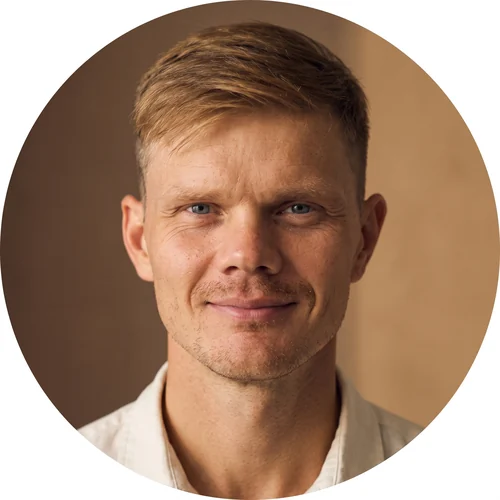
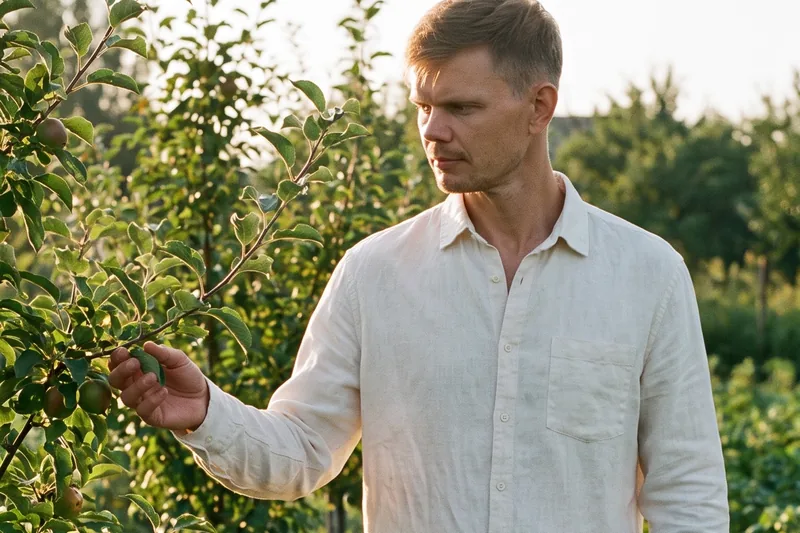
Igor Felitsin in a light linen shirt walking through a garden in morning light

The experience keeps working for several days afterwards — and it is worth giving yourself that time. Integration is not a pleasant extra; it is half the result.

The evening after
Worth keeping free: body and psyche need time to reorganise. No important meetings or errands “right after”.
Two weeks
A general recommendation: do not make abrupt life decisions. From a fresh expanded state a lot looks obvious — and looks different two weeks later.
Support
Part of the facilitator’s work. If difficult states come up after a session, write — that is exactly the situation I am available for.
Group meeting
A few days later — an online meeting: to compare notes, ask questions, let what was lived settle into words.
What next
A single deep experience sits well on top of a regular practice — and replaces it badly. If you want the long distance, there is “100 Days of Spirit”: a hundred days of daily work with body, breath, attention and meaning. The programme currently runs in Russian.

Frequently asked questions

questions
Is it safe?
The method has existed for more than fifty years and has been refined by hundreds of thousands of participants worldwide. The body has built-in self-regulation mechanisms: the protective mechanism of the cardiorespiratory system engages within the first minutes of intensive breathing. At the same time the load is comparable to serious athletic training — which is why there are contraindications, and why a session is accompanied by a sitter and a facilitator.
What will I feel?
There is no prescribed sequence of experiences: bodily sensations, emotions, images, memories — or a quiet, calm session. The psyche brings up exactly the experience that is needed now and doses the load itself. There are no “right” processes.
Who is a sitter and why are they needed?
A sitter is your partner for the duration of the session. They do not lead and do not interpret: they are present and ready to help if needed. When we touch vulnerable layers, it matters to know in the body that someone is continuously caring — without that anchor, part of the process simply does not unfold. Afterwards you switch roles, and sitting often turns out to be no less valuable than your own session.
Do I need to formulate an intention beforehand?
No. Grof recommends letting go of expectations and trusting inner wisdom: we formulate intentions from our habitual state, while in an expanded one we see ourselves and our real needs differently. A rigid agenda tends to interfere with the natural course of the process.
What if “nothing happens” for me?
A quiet session is still a session. The psyche doses the load itself, and the absence of fireworks often turns out to be the most precise experience available. There is a testimony about exactly this on this page — we publish it deliberately.
Will I lose control or consciousness?
No. This is a conscious practice: contact with reality is preserved even during very intense experiences, and at any moment you can return to normal breathing — the intensity will decrease. You control the depth of the process with your breath.
Do I need experience with meditation or breathing practices?
No. No preparation is required — everything you need is explained in the introduction at the start of the day. All you need is a basically stable condition (see contraindications) and a readiness to be open to whatever unfolds.
How does Holotropic Breathwork differ from rebirthing and Vivation?
The material is similar, the structure is different. Rebirthing and Vivation involve more guidance, more instruction and work with a specific theme. The holotropic approach has minimal instruction and maximal space: no assigned theme and no “correct” outcome, but very dense support of the process by the facilitator and the sitter, a long session to a carefully built musical arc, and mandatory integration afterwards. That frame is what makes the depth possible.
Can I come with a partner or a friend?
Yes. You can ask to be paired together, or, on the contrary, work with someone you do not know: both options have their advantages. Say what you prefer in the opening circle.
How do I prepare?
Get a good night’s sleep, avoid alcohol for a couple of days, ideally eat lightly the day before. Bring comfortable clothes for movement and a light snack. Nervousness and doubts before the practice are normal and natural — they spoil nothing.
When is the next workshop?
Dates have not been announced yet. Write to me and I will let you know personally when the next workshop is scheduled — or if you would like to talk first.

Tell me when there are dates

There are no dates yet. Write to me and I will let you know personally when a workshop is scheduled. No mailing lists and nothing beyond that.

Telegram @IF777 · WhatsApp · hey@daimo.life

Questions about whether the practice suits you are welcome — that conversation commits you to nothing.

Next

on this site